
You're a founder. You have a product you believe in, a team that's hustling, and a pipeline that should be fuller than it is. But somewhere between strategy, social media, campaigns, and conversion rates, marketing became your second full-time job. One you never applied for.
Here's the hard truth: most early-stage and scaling companies don't need a $250K/year Chief Marketing Officer on payroll. What they need is senior marketing leadership that can plug in fast, build structure, and drive results, without the overhead.
That's exactly what a Fractional CMO does. And in 90 days, the difference is night and day.
Most founders aren't bad at marketing. They're just too close to the business to see it clearly, and too stretched to do anything about it.
When founders try to run marketing themselves, a few things inevitably happen. Messaging gets inconsistent. Channels pile up with no clear priority. Money gets spent on ads or agencies with murky ROI. And the team waits for direction that never quite arrives with conviction.
It's not a hustle problem. It's a leadership gap. Marketing without a clear strategy at the top is like a sales team with no ICP, everyone's busy, nobody's winning.
Sound familiar? You have a marketing budget but no real strategy to back it. Your messaging changes depending on who's in the room. You've hired freelancers or an agency, but you're not sure they're pointed in the right direction. You know you need to scale, but you don't know where to start.
A Fractional CMO isn't a consultant who hands you a 60-page deck and disappears. They're an embedded senior leader, usually 2–3 days a week, who owns the marketing function and drives execution. And 90 days is more than enough time to feel the shift.
Before the 90 days even begin, we do something most marketing engagements skip entirely: we think before we act.
At Nexa Engage, every fCMO engagement starts with a 2-week Strategy Sprint. This is where we sit down with you, the founder, and build the actual plan together. We dig into your positioning, your audience, your current channels, what's working, what's draining budget, and where the real growth levers are. By the end of those two weeks, you don't just have a roadmap. You have clarity. You know exactly what the next 90 days will look like, what you're tracking, and why.
This is also where founders usually have their first "aha" moment. Maybe you've been pouring budget into Google Ads when your buyers aren't searching, they're being referred. Maybe your funnel has a conversion problem, not a traffic problem. Maybe you need to fix your messaging before you run a single campaign. The Strategy Sprint surfaces all of this before a cent gets spent in the wrong direction. No guessing. No "let's try this and see." Just a real execution plan, built with you, not handed to you.
Then the 90 days begin.
With the strategy already in hand, month one is about turning that plan into infrastructure. Your fCMO aligns the team, sets up the right tools and processes, nails down the messaging, and makes sure every channel you're running is pointed in the right direction. By day 30, your marketing has a spine, a clear story, a prioritised focus, and a team that knows exactly what they're working toward.
Month two is where things start moving. Campaigns launch. Content goes out. The fCMO manages execution, watches the early data, and adjusts fast. You start seeing signals, leads coming in, engagement picking up, pipeline starting to move. More importantly, you're making decisions based on real numbers, not instinct and hope.
By day 90, the guesswork is gone for good. You have a repeatable marketing engine: proven channels, a team with clear direction, and metrics that actually tell you something useful. Whether your fCMO stays on to keep scaling or hands off to an in-house hire, the foundation is solid. Marketing is no longer something that happens to your business, it's something that works for it.
Let's put the numbers on the table.
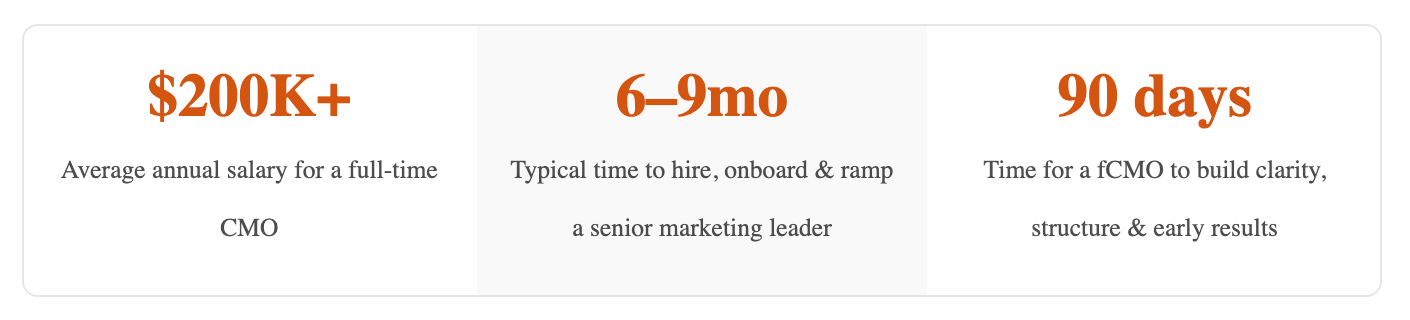
A Fractional CMO gives you the strategic firepower of a seasoned executive at a fraction of the cost, typically between $5K–$15K per month depending on scope. No benefits, no equity, no six-month onboarding runway. Just senior expertise, applied immediately.
For founders, scale-ups, and SMBs where every dollar counts, that's not just affordable, it's one of the highest-leverage investments you can make.
Here's what founders consistently say after working with a Fractional CMO: I finally know what we stand for.
That might sound soft. It's not. When your positioning is clear, everything gets easier. Sales has a story. Content has a direction. Ads convert better. Partnerships make sense. Hiring becomes easier because candidates understand what they're joining.
Strategic clarity isn't just a marketing outcome, it's a company-wide unlock. And it's often the single most valuable thing a fCMO delivers in their first 30 days.
Beyond the timeline, here's what you should expect a quality Fractional CMO to produce for your business:
A positioning framework: who you are, who you serve, and why you win. Written down. Agreed upon. Used consistently across every touchpoint.
A channel strategy: not "let's try everything," but a clear, prioritised view of where to focus based on your audience, your goals, and your stage of growth.
A functional team or agency setup: whether that's managing existing freelancers, briefing agencies properly, or building a small in-house team, you get structure and accountability.
A measurement framework: the right KPIs for your stage, tracked in a way that informs decisions rather than just filling a dashboard.
Momentum: campaigns running, content flowing, leads moving. Not in a year. Now.
The biggest ROI from a fCMO isn't the campaigns they run. It's the clarity and direction they bring to everything else.
A fCMO is the right move if you're a founder who's been wearing the marketing hat too long and knows it. If you're scaling and need senior leadership but can't justify a full-time exec hire yet. If you've got budget, an agency, or a junior team, but no one steering the ship with real conviction.
It's also right if you've had a marketing hire that didn't work out, and you want to build the strategy first before you hire into it. Smart move, by the way.
It's probably not the right fit if you're pre-product, pre-revenue, or still figuring out your customer. At that stage, a fCMO will help you think more clearly, but they can't manufacture product-market fit.
If you're past that point? There's genuinely no reason to keep struggling with marketing alone.

Start with a Strategy Sprint. We’ll define, build, and operate your Growth Control System.